Each week, Steve is breaking down what’s happening in fintech banking with the kind of clarity you get from someone who’s lived through board debates, pricing standoffs, and product launches that either scaled or crashed. This isn’t surface-level commentary. It’s the real story behind sponsor bank partnerships, embedded finance moves, and BaaS programs that most people only hear about after they’ve already succeeded or failed.
The FDIC Studies the Agent. Sezzle Applies to Be the Bank.
Agent access gets regulatory attention. Sezzle and Ramp seek different charters. Cross River agrees to buy Accrue, while Pathward shows what sponsorship earns and costs.
As if a special edition wasn't enough.
Link to Special Money 2020 Edition: Banks - Here Comes the Run
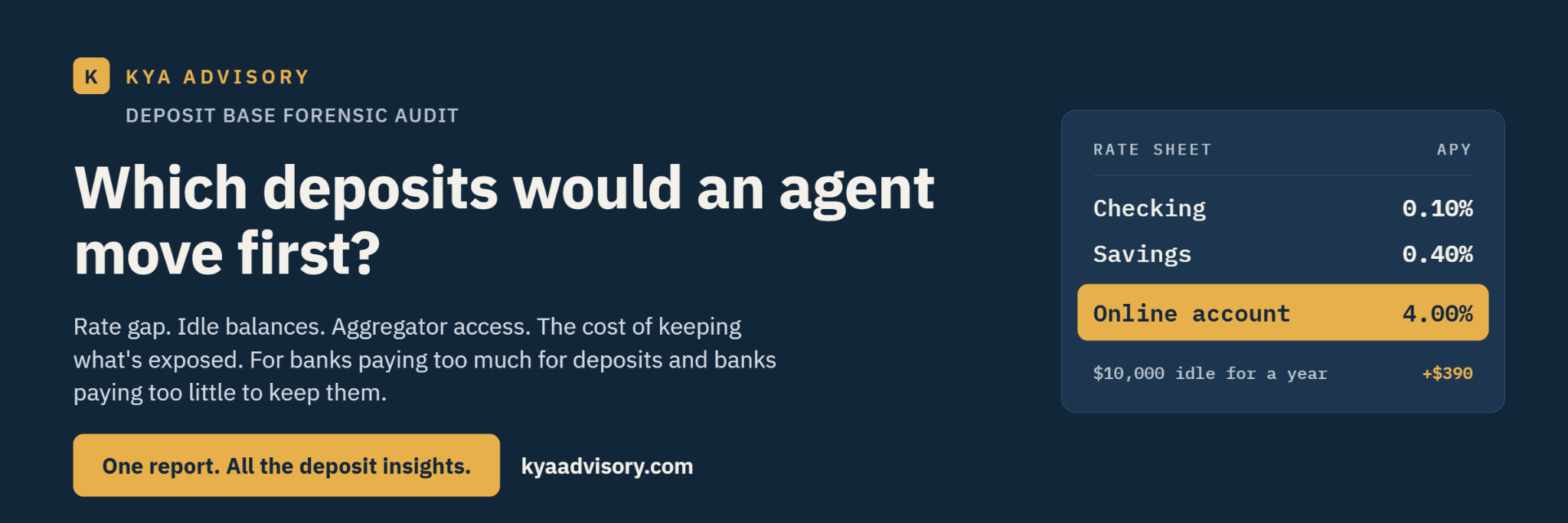
Which deposits would an agent move first? KYA Advisory's Deposit Base Forensic Audit examines rate sensitivity, concentrations, access permissions and the cost of keeping exposed balances. For institutions trying to lower funding costs or protect the cheap funding they have. One report. All the deposit insights. Go deeper if the numbers call for it. www.kyaadvisory.com
Advertisement
Agent Rules, Charter Applications, and the Sponsor Bank's Next Invoice
The regulator is considering guidance, but the agent already has a login.
At an October 20 Axios event in Las Vegas, FDIC Chair Travis Hill said revised model risk guidance doesn't work well for generative or agentic AI. He is considering public input on future guidance. What to do: Test how an agent gets permission, acts and loses access.
■
Hill's deposit question is how many customers will delegate decisions and how much money could move.
■
He noted that corporate customers may accept lower yields for other services. A rate comparison misses that bargain.
■
Reuters reported Morgan Stanley blocks outside agents but had seen no unauthorized or rogue-agent incidents on its systems.
■
Banks are detecting shared-credential access. Reuters’ sources say those transfers can’t be called unauthorized once the customer shared the login.
For sponsor banks: Define approved connections, permitted actions and transfer limits.
For fintechs: Get the bank's access rules before promising automation.
For compliance teams: Preserve consent and revocation records; investigate disputed transfers under applicable rules.
The partner expanded the program. Then it applied to become a bank.
Sezzle announced October 22 that it applied for an OCC national bank charter and FDIC deposit insurance; a Federal Reserve holding-company application will follow. What to do: Model which partner revenue could move after approval, without inventing a departure date.
■
The proposed bank would offer checking, savings and credit products to app-first consumers, including those new to credit.
■
WebBank remains the exclusive originator, subject to limited exceptions, under a program whose initial term ends September 27, 2029.
■
August amendments added SezzleCash and Sezzle Send, with an initial $30 million loan-retention threshold that WebBank may raise to $150 million.
■
Sezzle says existing lending partnerships continue. The application has not canceled the contract. Lawyers remain inconvenient that way.
For sponsor banks: Review exclusivity, termination rights and transition economics.
For fintechs: Budget for both the proposed bank and existing partners.
For compliance teams: Map servicing and complaint duties if new originations eventually move.
Advertisement
Your Agent Has Access. Know Who Granted It.
Know Your Agent helps document who approves an agent’s actions, monitors its work, and can shut it down.
Order at kyabook.com.
Advertisement
Ramp wants a charter with a different job description.
Ramp filed October 16 for a national trust bank charter covering fiduciary investment management and digital-asset custody. What to do: Read the proposed activities before forecasting the loss of every bank fee attached to the client.
■
Ramp says the proposed bank would not take deposits or make commercial loans.
■
It plans to operate alongside banking partners. Federal charter does not mean full-service replacement.
■
The filing follows ICBA’s October 2 lawsuit challenging the OCC’s trust-chartering approach. A lawsuit supplies uncertainty and no timetable.
Cross River's parent, CRB Group, agreed October 20 to acquire Accrue, adding branded wallets, stored value and loyalty capabilities. What to do: Ask which parts of your offering the bank could now supply itself.
■
Accrue adds customer-facing software to Cross River's existing accounts, payments, cards and lending capabilities.
The deal remains subject to closing conditions. An announcement moves no balances and rewrites no program agreements.
■
Partners could buy more functions from one provider. That gives independent wallet vendors a harder renewal conversation.
For sponsor banks: Compare product ownership with the costs of building and supporting it.
For fintechs: Clarify customer, data and distribution rights before integrating further.
For compliance teams: Verify balance ownership, insurance disclosures and transition responsibilities.
Advertisement
Fintech NerdCon: Bring the People Who Have to Make It Work
Fintech NerdCon lands November 19 to 20 at the San Diego Convention Center, with Fintech Confidential recording live. The people promising the launch date should meet the people responsible for making it happen.
Pathward's fiscal fourth-quarter originations rose to $2.2 billion from $1.3 billion, primarily through credit sponsorship. What to do: Separate fees, funding payments and credit exposure before calling volume a victory.
■
Noninterest income rose 12% to $65.6 million; servicing deposits held at other banks generated $6.1 million.
■
A prior portfolio sale affected reported net interest margin, which fell; adjusted margin rose to 5.51% from 5.43%.
■
The reported deposit cost was 0.01%; including rate-related partner payments raised it to 1.40%. Cheap deposits still come with invoices.
■
Nonperforming loans and leases reached 5.61%, versus 2.05% a year earlier, mainly reflecting renewable-energy construction projects sharing a developer.
For sponsor banks: Show program returns after partner payments and credit costs.
For fintechs: Understand which revenue pays for your sponsor relationship.
For compliance teams: Track concentrations across related projects and counterparties, beyond program labels.
Conclusion of the week:
Know what the partner still needs you for
Sezzle and Ramp want different banking powers. Cross River wants more of the product. Pathward earns fees on money held elsewhere while carrying credit risk at home. A sponsor needs a clear account of what it provides, what it earns and what it remains responsible for when the partner changes plans. The logo on the account answers very little.
Takeaway from Week:
❝
A charter application changes the conversation. The contract and the economics decide what happens next.
Stephen Bishop
Final Thoughts
Pick one major program. Identify what the partner could replace, what it would still need, and your obligations either way.
Sign-off:
I sent a special edition on agents Friday. Apparently the subject has authorized recurring payments.
From The Source
For those of you wanting a more in-depth look at the articles (and the links to them…)